ISOGANTS turning used construction gloves into insulation fibres

Dans cette page :
- An idea born on a construction site in Brest
- Gloves everywhere, but a new question: what can be done with them?
- From the kitchen to the construction site: experimentation as a method
- Encouraging initial thermal results
- Turning waste into a resource: collection at the heart of the project
- A protected innovation and a project that continues after graduation
- The next challenges: moving from a prototype to an industrially scalable solution
- An innovation born from a work-study programme
What if used construction gloves could become a resource for the building industry? That is the challenge taken on by Alexis Le Dez, a recent engineering graduate from CESI Brest. As part of his final-year project, completed during his work-study programme at GCC, he developed ISOGANTS, a project that aims to turn used cut-resistant gloves into textile fibres for insulation. An innovation inspired by on-site experience, at the intersection of the circular economy and the construction industry.
An idea born on a construction site in Brest
Alexis Le Dez has just completed his engineering studies at CESI Brest: two years of an integrated preparatory programme, followed by a three-year civil engineering programme combining academic study with work at GCC.
During his work-study programme, he worked as a construction engineer, first in site management and then in project and client management. It was this hands-on experience that sparked the idea for his final-year project.
While working on a €3.3 million structural construction project for a senior living residence in Brest, Alexis took an interest in the number of cut-resistant gloves used by the site workers.
Over the 18-month project, with an average of eight workers on site, more than 2,000 pairs of gloves were ordered, costing around €4,500.
This level of consumption is largely explained by working conditions: moisture, dirt and wear mean that workers need to replace their gloves regularly.
But this intensive use raises another question: what happens to all these gloves once they are worn out?
Gloves everywhere, but a new question: what can be done with them?
Through discussions with other professionals, Alexis found that the same issue arose on many construction sites.
Initiatives for recycling personal protective equipment (PPE) already exist. Ansell’s RightCycle programme, for example, enables certain eligible items of PPE to be collected and recycled.
But Alexis wanted to explore another approach: what if these gloves could become a resource for the building industry itself?
He began by looking into their composition.
Cut-resistant gloves are made from several materials, including textile fibres designed to resist cuts. They may also be contaminated with dirt and other substances from their use on construction sites.
This variety is both a characteristic of the waste and one of the challenges facing the project.
However, Alexis identified a promising avenue: textile fibres can be used in certain insulation solutions.
The idea behind ISOGANTS began to take shape: turning used gloves into a fibrous material that could be used to produce insulation.
From the kitchen to the construction site: experimentation as a method
To process the gloves, Alexis first had to solve a fundamental problem: how could he shred them?
The fibres in the gloves are tightly bound together. His initial experiments did not produce the expected results.
Alexis tried different solutions using whatever equipment was available: first a kitchen grinder, then a lawnmower.
Neither worked. But he kept searching.
While walking through a market, he came across a system that used porous grinding stones rotating at very high speed to sharpen knives. Intrigued by the principle, he decided to try a second-hand bench grinder.
This time, the result was different: the high speed opened up and separated the fibres enough to produce usable textile fibre.
It was a decisive first step in the development of ISOGANTS.
Encouraging initial thermal results
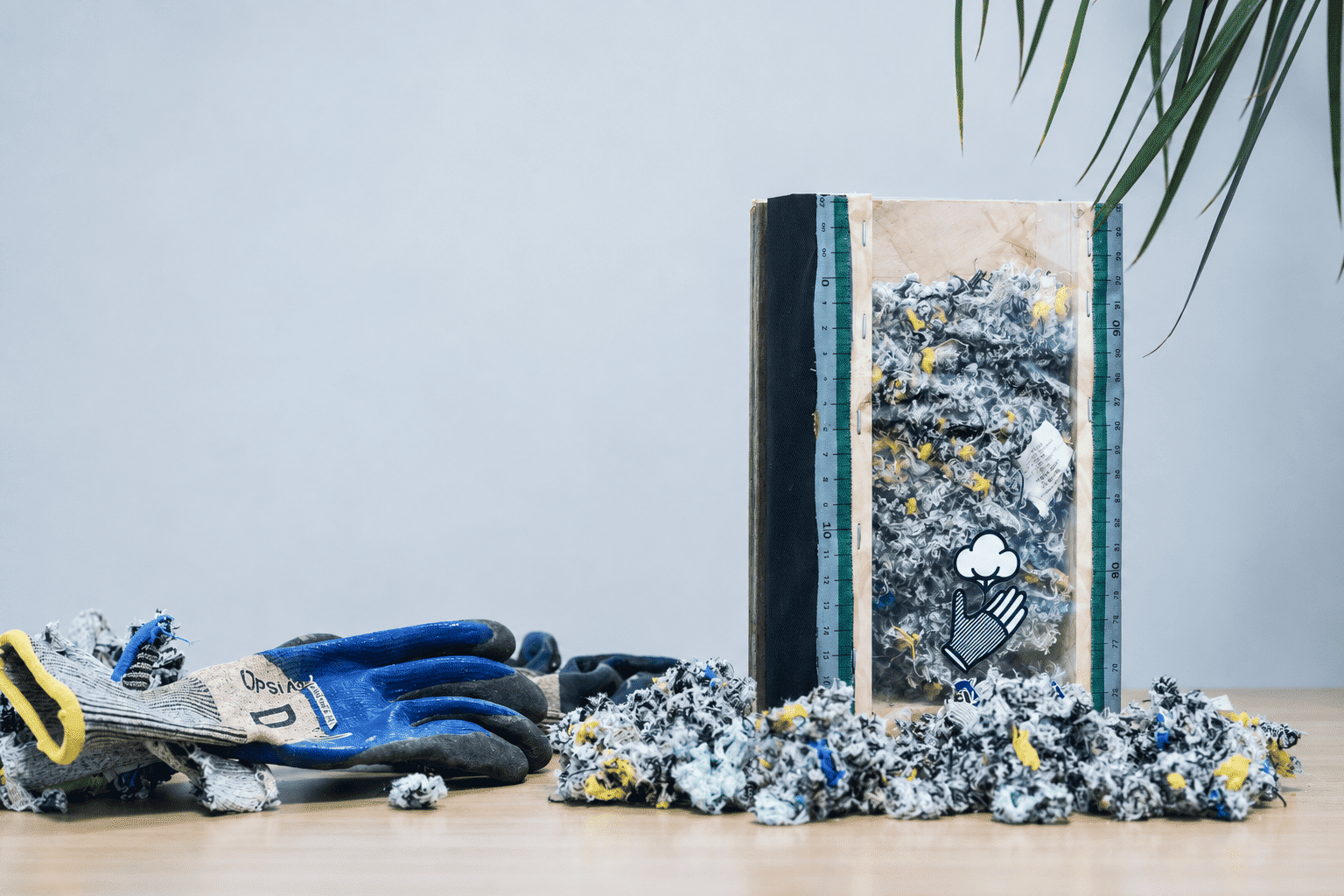
Once he had obtained the fibre, Alexis needed to check whether it had useful properties for insulation.
He carried out a comparative test using physical models, monitoring changes in temperature in particular. The initial measurements provided estimates of thermal conductivity and thermal resistance that appeared promising. These results represent an encouraging first step for the project.
However, they do not yet establish ISOGANTS as a market-ready insulation product. Before it can be used in the building industry, the material will need to be characterised and undergo the necessary testing and certification, particularly regarding its thermal and acoustic performance and its reaction to fire.
Turning waste into a resource: collection at the heart of the project
For Alexis, innovation is not limited to the processing method. It also means thinking about how to collect the gloves directly from construction sites.
His idea is simple: place a collection bin in the site manager’s office, or provide a dedicated bag in vehicles for mobile worksites.
The aim is to make collection visible, straightforward and easy to integrate into workers’ routines, without substantial investment.
This approach could also help keep work areas cleaner.
The collected gloves could then be sent to a processing stream.
ISOGANTS is therefore based on a circular economy loop: collecting waste where it is generated and seeking to give it new value within the same industry.
A protected innovation and a project that continues after graduation
Throughout his final-year project, Alexis discussed the progress of his research with his manager at GCC.
The ISOGANTS project is now the subject of a patent and a concept registered with INIPI.
Alexis will also take part in GCC’s innovation competition.
His career with the company is continuing too: after three years on a work-study programme, he has just been hired on a permanent contract at GCC.
His goal now is to continue developing ISOGANTS and secure the resources needed to bring it to industrial production.
The next challenges: moving from a prototype to an industrially scalable solution
Several steps still need to be completed.
The first is to make the resulting fibre more consistent, as the collected gloves may vary in composition and degree of contamination.
The process will also need to be automated to handle large volumes, followed by all the necessary testing before use in the building industry can be considered.
To take this work forward, Alexis is considering raising funds and finding an industrial partner.
The ambition is to develop ISOGANTS into a solution that addresses the construction sector’s circular economy challenges.
ISOGANTS is a project that is particularly close to my heart. I am proud of how far I have come, because despite the difficulties encountered, being able to present this innovation is already an initial achievement, even though the hardest part is still ahead. -Alexis
An innovation born from a work-study programme
Alexis’s journey also illustrates how an engineering education can give rise to projects directly connected to the challenges faced by a company.
After two years of an integrated preparatory programme, he completed a three-year civil engineering programme at CESI Brest, combining academic study with work at GCC. His experience in site management and project and client management gave him practical insight into on-site operations.
His final-year project then gave him the opportunity to turn an observation made on a construction site into an innovation challenge, and then into a prototype.
With ISOGANTS, Alexis shows that an engineering idea can sometimes begin with a very simple question: what could we do differently with something we currently consider waste?