A Look from Researchers – Varsha DEVI
On this page :
- Can you introduce yourself and tell us about your background, and what has shaped the way you conduct research today ?
- What does your research focus on today, and what are the main scientific challenges you address ?
- As a woman in a field that is still largely male-dominated, how have you experienced your career in AI ?
3 questions to Varsha DEVI
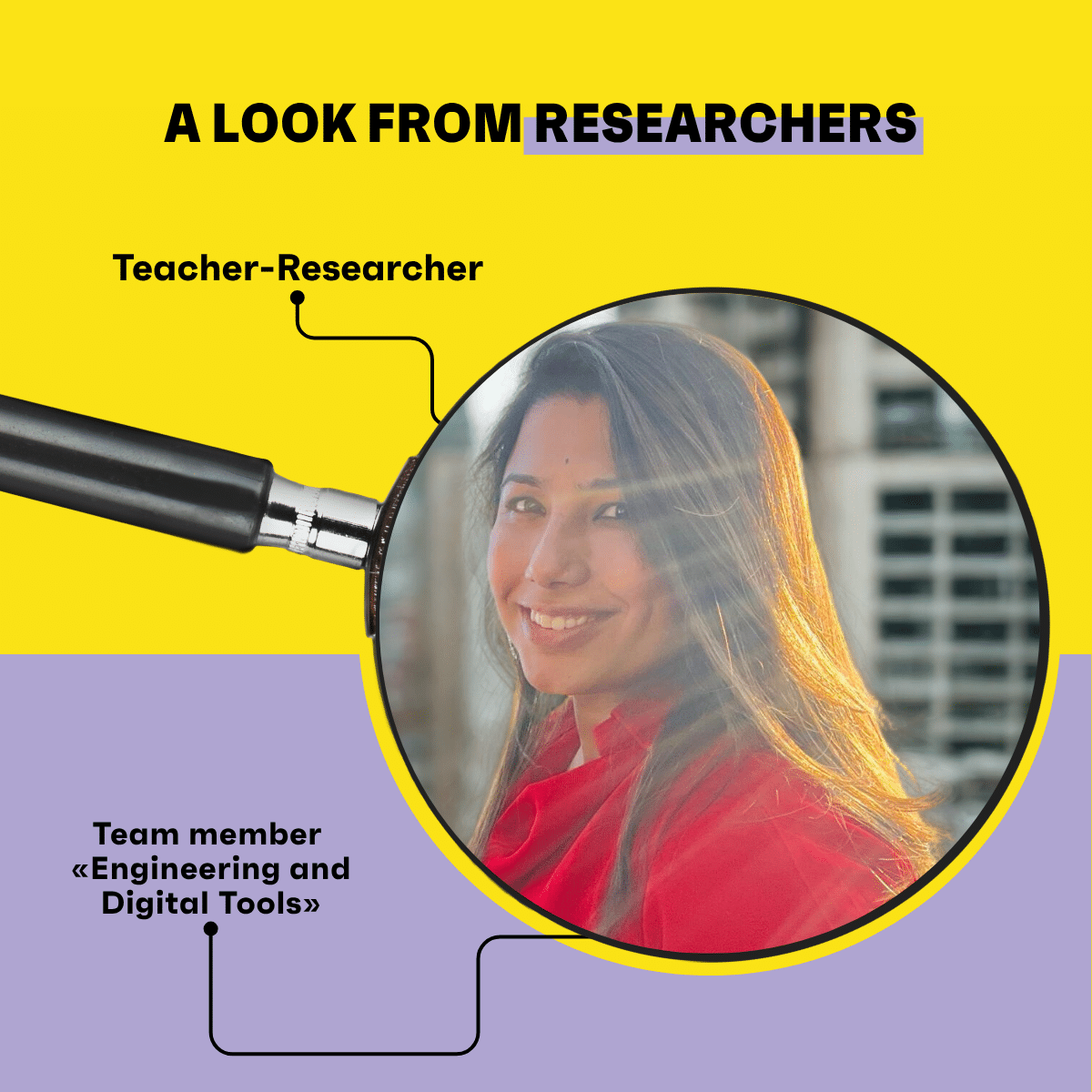
Teacher–Researcher, CESI LINEACT Research Unit and member of the Engineering and Digital tools team at CESI LINEACT.
Arriving at the CESI Nice campus in September 2024, Varsha Devi is a researcher within the CESI LINEACT research unit. Her work focuses on emotion and activity recognition through artificial intelligence. At the intersection of causality, explainability, and digital health, she develops AI systems capable of better understanding human states, particularly in contexts where emotional expression is difficult.
Can you introduce yourself and tell us about your background, and what has shaped the way you conduct research today ?
My name is Varsha Devi, and I joined CESI at the Nice campus in September 2024. When I arrived, there were only two researchers working on artificial intelligence–related topics on this campus.
Before joining CESI, I worked in the field of artificial intelligence throughout my master’s and doctoral studies. My PhD focused mainly on causality and explainability in AI models crucial topics, as many high-performing models still remain true “black boxes” today. I worked extensively on understanding why a system makes a particular decision, especially in human–system interaction contexts.
Before coming to CESI, I was also involved in projects related to smart classrooms, where we used emotion recognition techniques based on facial expressions in an educational setting. These experiences allowed me to explore the limitations of AI models at an early stage and to develop a critical perspective on their reliability and interpretation.
I began working in the field of artificial intelligence around 2016, and over the course of my journey, I became aware that AI models cannot be trusted blindly. This realization profoundly shaped my approach to research and led me to focus closely on explainability and causality during my PhD.
Today, my work is more oriented toward medical and digital health applications. We aim in particular to detect and understand emotions in people who have difficulty expressing them, such as individuals with autism or ADHD. During my PhD, I also collaborated on the design of an AI agent capable of understanding emotions through speech in therapeutic contexts, especially for people suffering from depression and who are uncomfortable with direct human interaction.
All of these experiences have shaped my current research approach, with a clear objective: to develop intelligent, explainable, and deeply human-centered AI systems. Since joining CESI, I have been working closely with Amine Bohi to further develop and advance this work.
What does your research focus on today, and what are the main scientific challenges you address ?
Today, my research is more oriented toward medical and digital health applications. We seek in particular to detect and understand emotions in people who have difficulty expressing them, such as individuals with autism or ADHD.
During my PhD, I also collaborated on the development of an AI agent capable of understanding emotions through speech in therapeutic contexts, particularly for people suffering from depression and who are uncomfortable with direct human interaction.
From a scientific perspective, my current research aims to improve emotion recognition systems by integrating multiple sources of information, known as multimodal data. At present, we mainly work with visual information, such as images or videos. However, emotions are not expressed solely through facial expressions; they are also conveyed through gestures, speech, and body movements.
One short- to medium-term objective is therefore to design AI systems that are more robust, more nuanced, and closer to real human behavior by combining these different modalities.
A major scientific challenge also concerns the integration of context. Introducing contextual information into AI models is essential, but it can also generate biases. These biases must be carefully limited in order to make the models truly usable in real-world environments, particularly in digital health or interactive AI agents.
What does your research focus on today, and what are the main scientific challenges you address ?
It is true that artificial intelligence remains a predominantly male field. Most of my supervisors and collaborators have been men.
However, I never felt discouraged. I was deeply invested in my work, and when you are truly passionate about AI and innovation, gender becomes less central in everyday practice.
I would like to tell young women that they should not believe they are less capable of innovating. AI is above all about ideas and creativity. If you have an idea and can implement it, then you absolutely belong in this field.
I am convinced that women often bring a different and highly relevant perspective to these challenges, which is a real asset for research. AI is also a very motivating field, as you can quickly see the concrete results of your work. I strongly encourage women to pursue these careers and to bring their own perspective and creativity to them.
Varsha’s advice to future researchers :
Artificial intelligence is now omnipresent. It must be able to understand humans in a natural way, by taking into account emotions, gestures, and speech. It is a field of research that is both technically demanding and deeply human, where innovation must always remain in the service of people.
Varsha DEVI